
United States: Section 338 additional 50% duties on listed Canadian-origin goods have applied since 12:01 a.m. ET, August 22, 2026. USMCA/CUSMA origin does not exempt listed goods. Product-list changes from the September 8 proclamations took effect September 15. Some goods can now face Section 338 stacked on Section 232.
Canada: Counter-surtaxes of 15%, 25%, and 50% on a published list covering about C$27.6 billion of U.S. imports have applied since 12:01 a.m., September 8, 2026. Rates match the corresponding U.S. Section 338 / 232 rate. Steel and aluminum items that already carried a 25% Canadian counter-tariff generally moved to 50%. Canada’s existing 25% surtax on U.S. autos remains. Goods in transit to Canada on September 8 were excluded.
Next date: September 29, 2026 — U.S. import prohibitions (not extra duty) on certain Canadian alcohol and dairy products. A separate U.S. warning of 50% duties on Canadian cars, trucks, and parts starting January 1, 2027 has been announced; it is not in force yet. Confirm classification on the official lists, not on this page.
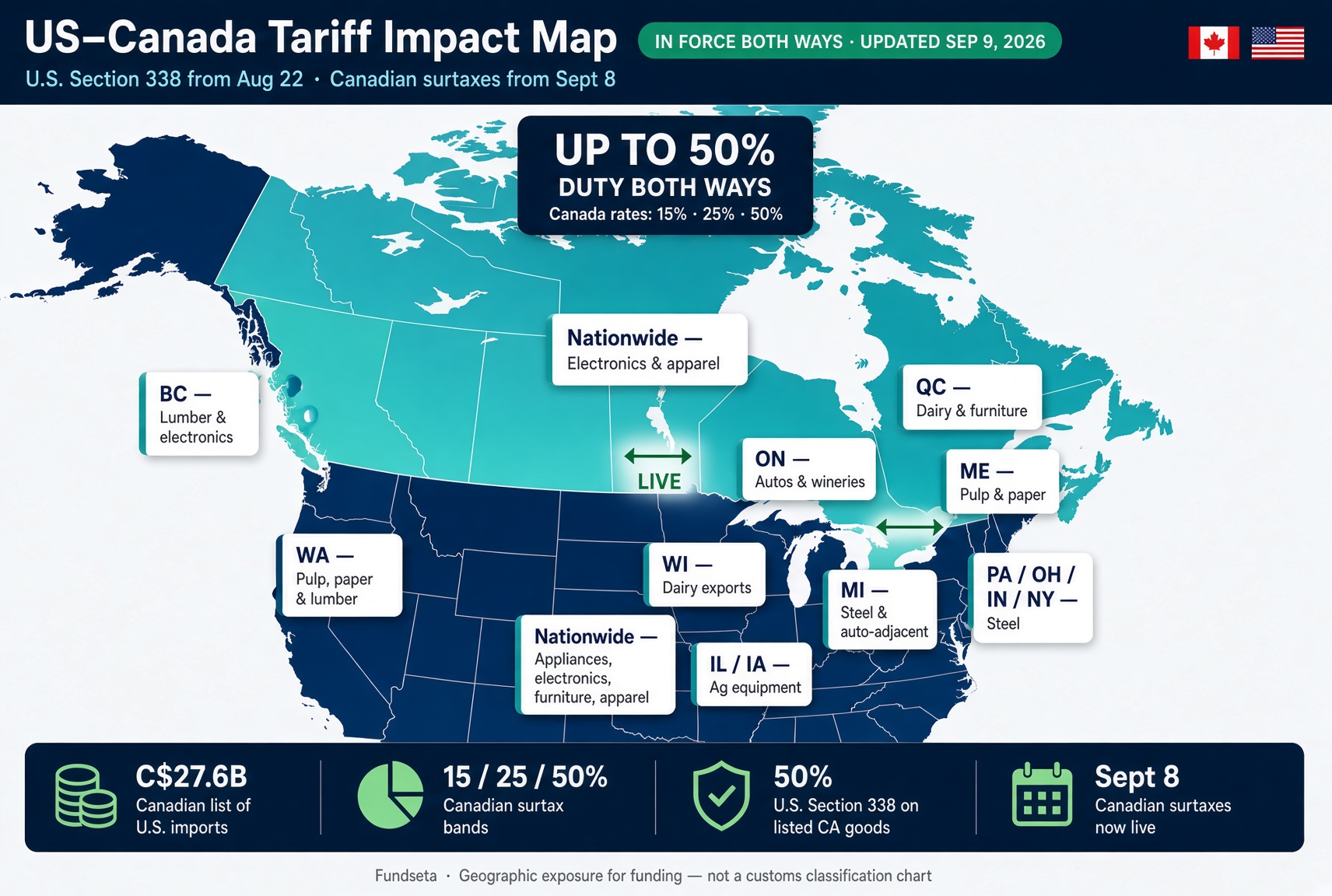
On July 20, 2026 the White House signed three proclamations under Section 338 of the Tariff Act of 1930, adding a 50% duty on listed Canadian goods tied to motor vehicles, alcoholic beverages, and dairy. Talks broke down. The duties took effect together at 12:01 a.m. ET, August 22. Canada answered dollar-for-dollar on September 8. The U.S. answered again the same day with five further proclamations — list changes on September 15, import bans on September 29.
Confirm HTS / HS codes on the official annexes and the Finance Canada product list. This page is a briefing, not a classification tool.
Who is exposed
Canadian exporters into the U.S.
If your goods sit in a Section 338 basket, the extra 50% is collected at the U.S. border. Since September 15 some lines also stack with existing Section 232 metals or auto-related duties. From September 29, certain alcohol and dairy lines are not dutiable — they are barred from entry.
U.S. sellers into Canada
If you ship U.S.-origin product on the September 8 list, the Canadian surtax is 15%, 25%, or 50% and it is due before your Canadian buyer pays you. Steel and aluminum that already faced 25% generally moved to 50%. The 25% Canadian surtax on U.S. autos did not go away.
Industry snapshot
| Sector | What changed | Funding path that usually fits |
|---|---|---|
| Steel & aluminum | Canadian counter moved 25% to 50% on many items; U.S. 338 can now stack with 232 on some lines | Revenue-based working capital for deposit-rich shops and fabricators |
| Dairy | 338 basket since Aug 22; Canadian counters on U.S. dairy; U.S. import bans on some Canadian dairy from Sept 29 | Revenue-based if monthly deposits are steady |
| Alcohol | 338 basket since Aug 22; U.S. import bans on some Canadian alcohol from Sept 29 | Revenue-based for distributors with deposits; credit-based for newer importers |
| Appliances, electronics, pulp & paper | On Canada’s Sept 8 list at matching 15/25/50% rates | Revenue-based for established sellers into Canada |
| Ag equipment, furniture, apparel | On Canada’s Sept 8 list; some U.S. list changes Sept 15 | Revenue-based or equipment-style working capital |
| Autos & parts | Canada’s 25% U.S.-auto surtax remains; U.S. 50% warning for Jan 1, 2027 is not live yet | Talk to an advisor — product and timing both matter |
This is a cash-flow problem
The tariff is not an income-statement curiosity. Duty is cash out the door at clearance, often weeks before the receivable lands. That is the same squeeze as slow broker pay in trucking or a 45-day restaurant supplier term — except the bill is now bigger, and it is not optional. Banks underwrite last year’s tax return. The gap is this month’s landed cost.
Fundseta is a funding marketplace and does not classify goods. We match U.S. and Canadian operators to a revenue-based or credit-based path, with an advisor on the file and no hard pull to check.
FAQs
Does USMCA or CUSMA exempt listed goods?
No. Listed goods still carry the extra U.S. or Canadian measure. Check the official annex or Finance Canada schedule for your code.
Are Canada’s September 8 counter-tariffs in force?
Yes, since 12:01 a.m. September 8, 2026, at 15%, 25%, or 50% on the published list covering about C$27.6 billion of U.S. imports. Goods in transit to Canada that day were excluded.
What changed after September 8?
U.S. list revisions took effect September 15. Some goods now face stacked 232 + 338 treatment. Import prohibitions on certain Canadian alcohol and dairy take effect September 29.
Is this legal or customs advice?
No. Confirm classification and origin with a customs broker or trade counsel. Fundseta is an alternative funding marketplace — not a customs broker and not a trade advisor.
How can funding help if tariffs raised my costs?
Working capital covers the weeks between duty paid and customer paid. Checking a path on Fundseta does not require a hard credit pull.
Sources: Department of Finance Canada news release and product list (Aug 25-26, 2026); CBSA customs notices; White House Section 338 proclamations (July 20 and Sept 8, 2026); BDO Canada briefing updated Sept 8, 2026; U.S. Department of Commerce / trade.gov market note Sept 8, 2026. Always verify against the current official schedule.