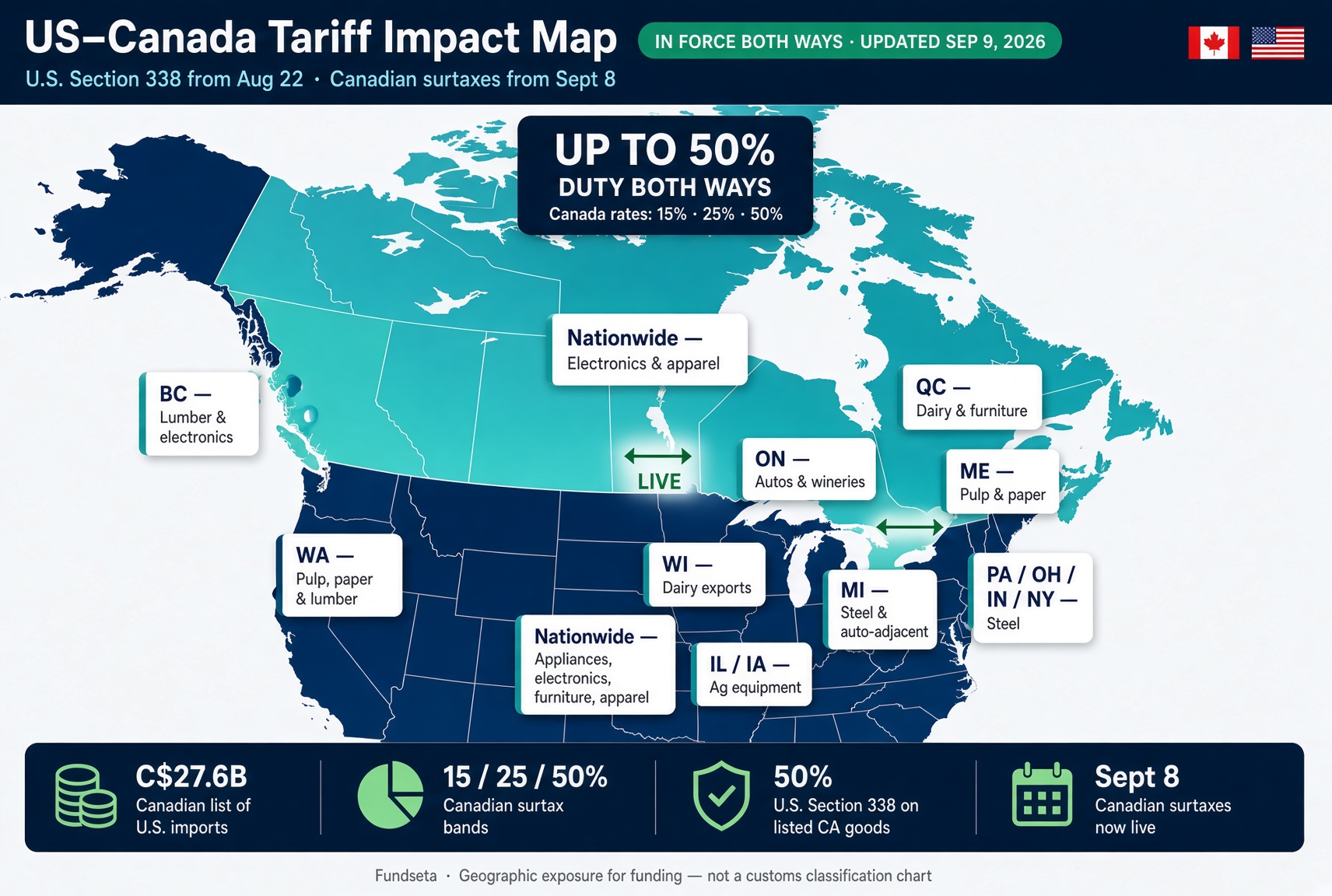
On July 20, 2026, the White House signed three separate proclamations invoking Section 338 of the Tariff Act of 1930 — a rarely used, decades-old authority that had essentially never been invoked this way before. Each proclamation adds a 50% duty on top of existing tariffs for a distinct set of Canadian goods, tied to disputes over motor vehicles, alcoholic beverages, and dairy. The deadline was briefly pushed back, but with talks between Washington and Ottawa breaking down, all three took effect together — 12:01 a.m. Eastern Time, August 22, 2026.
Sources: Prime Minister of Canada remarks, Aug 22, 2026; NPR, AP, Reuters, Globe and Mail, NBC News, Al Jazeera wire coverage, Aug 22–23, 2026.
Sources: White House proclamations, July 20, 2026; U.S. Trade Representative; Holland & Knight, White & Case, Wiley legal advisories, August 2026.
What's actually covered
Each proclamation names a headline category, then reaches much further through its annex. The motor-vehicle proclamation alone runs 439 tariff lines across 18 pages — businesses in or adjacent to any of these categories should check their specific HTS codes against the official annexes, not just the headlines:
| Proclamation | Core goods | Also reaches into |
|---|---|---|
| Motor vehicles | Cars, trucks & auto parts | Agricultural products, textiles, wood products, cement, furniture, consumer goods, and select machinery & electrical equipment (e.g. refrigeration, filtering, and filling/sealing or mixing/grinding machinery) |
| Alcoholic beverages | Beer, wine, cider & distilled spirits | Other fermented beverages |
| Dairy | Milk, cream, butter & cheese | Whey, lactose, casein, and other downstream dairy preparations (~52 tariff lines) |
Also named across the annexes: plywood & engineered wood panels, fishing rods and other hockey equipment, seeds, clothing, swimming pools, and wigs, among hundreds of individual eight-digit HTS lines. Sources: Holland & Knight, Morrison Foerster; FreightFigures product-list analysis, July–August 2026.
The scale — and why the number matters
The U.S. Trade Representative puts total exposure at approximately $20 billion in Canadian imports — about 5.2% of the roughly $382 billion in goods the U.S. imported from Canada in 2025. That's a real, concentrated hit to the businesses in these specific supply chains, even though it's a slice of overall U.S.–Canada trade rather than the whole relationship. If you're in one of the affected categories, the exposure isn't diluted by that broader number — it lands fully on you.
Cause, effects & major impacts
Why this happened
Section 338 of the Tariff Act of 1930 is an unusual tool: unlike Section 232 or Section 301, it does not require an investigation, public comment period, or formal agency findings before duties take effect — only a presidential finding of discrimination against U.S. commerce and 30 days’ notice. That is part of why this move caught so many importers off guard.
The administration ties each proclamation to a specific complaint. On motor vehicles, it points to Canada’s 25% tariff on non-USMCA vehicles and a tariff-rate-quota system it says is built to favor domestic production — set against a roughly 22% drop in U.S. vehicle exports to Canada (about $25.9B to $20.3B, April 2025–March 2026). On alcohol, it cites Ontario’s LCBO and Quebec’s SAQ delisting American products from shelves starting in March 2025, alongside a roughly 81% collapse in U.S. alcohol exports to Canada (about $718M to $137M). On dairy, it argues Canadian retailers can draw on CETA quotas for European cheese but lack equivalent USMCA access for American cheese.
Sources: White House proclamations; Morrison Foerster and Holland & Knight legal advisories, July–August 2026.
Who's exposed on each side of the border
The pain runs in both directions, just in different forms — Canadian producers absorb the disputes and lost sales, U.S. importers pay the duty at the border:
Canada — absorbing the US tariff (live now)
United States — absorbing Canada's retaliation (Sept 8)
The bigger economic picture
Beyond the businesses named above, economists have flagged two knock-on effects: higher consumer prices on cars, wine, cheese, and furniture as the added cost works through supply chains, and inflation pressure that both governments are watching closely. RBC Economics estimates the new Section 338 tariffs alone could shave roughly 0.4% off Canadian GDP, with upwards of 20% of production and jobs in Canada's electronics and apparel sectors exposed. Now that Canada's own retaliatory tariffs are set to land September 8, the same dynamic runs in reverse for US exporters in steel, dairy, appliances, agricultural equipment, pulp & paper, and electronics — and businesses on both sides of the border are the ones carrying that cost pressure in the meantime.
Industry & region impact matrix: who's exposed, and which funding path fits
Not every impacted industry needs the same kind of capital. A business with steady daily or weekly deposits — even without perfect credit — is usually the fastest match for revenue-based funding. A business (or owner) with strong personal credit but thinner or newer revenue, including pre-revenue US startups, is usually the better match for credit-based funding. The table below maps the industries and regions named in the tariff proclamations and Canada's retaliation to the funding path that tends to fit best.
| Industry | Country / most-exposed regions | Why it's exposed | Likely funding fit |
|---|---|---|---|
| Dairy & dairy processing | Canada (national) & US — Wisconsin, New York, Minnesota, Idaho | Named directly in both the US dairy proclamation and Canada's retaliation list | Revenue-based (steady wholesale deposits) or credit-based for equipment/expansion |
| Motor vehicles & auto parts | Canada — Ontario; US — Michigan, Indiana, Ohio | Core target of the US motor-vehicle proclamation; deepest cross-border supply-chain integration of any sector | Revenue-based for suppliers with recurring OEM deposits |
| Alcohol production & distribution | Canada — Ontario (LCBO), Quebec (SAQ), BC wineries | Central to the US alcohol proclamation; lost shelf placement compounds the tariff hit | Revenue-based, fastest for producers with consistent retail/distributor deposits |
| Steel & primary metals | US — Pennsylvania, Ohio, Indiana, Michigan; Canada — Ontario, Quebec | Named in Canada's retaliation list; already carries prior Section 232 exposure on both sides | Credit-based for capital-intensive retooling; revenue-based for working capital |
| Pulp, paper & wood products | Canada — British Columbia, Quebec; US — Maine, Wisconsin, Washington, Georgia | Named in Canada's retaliation list and in the US motor-vehicle proclomation's wood-products annex | Revenue-based for mills with steady shipment cycles |
| Appliances & electrical equipment | Canada — Ontario, Quebec, British Columbia; US — nationwide manufacturers | Named in Canada's retaliation list; RBC flags up to ~20% of Canadian electronics production/jobs as exposed | Credit-based for larger-ticket manufacturers; revenue-based for smaller assemblers |
| Agricultural equipment | US — Illinois, Iowa, Wisconsin; Canada — Prairie provinces (as buyers) | Named in Canada's retaliation list | Credit-based for dealers financing inventory; revenue-based for service/parts operations |
| Furniture & home goods | Canada — Quebec, Ontario; US — importers/retailers nationwide | One of the largest dollar categories in the US motor-vehicle proclamation's annex | Revenue-based for retailers carrying inventory through the tariff hit |
| Construction materials (cement, plywood) | Canada — British Columbia, Quebec; US — buyers nationwide | Named across the US proclamation annexes | Revenue-based working capital to smooth input-cost spikes |
| Trucking & freight/logistics | Both countries — border-crossing corridors: Michigan–Ontario, New York–Quebec, Washington–BC | Not directly tariffed, but absorbs volume swings and compliance costs from both tariff regimes | Revenue-based, matched to deposit cycles from freight receivables |
Sources: White House Section 338 proclamations & fact sheet, July 2026; RBC Economics, Aug 2026; The Globe and Mail (Quebec/BC/Ontario exposure analysis), Aug 2026; Progressive Policy Institute (state Canada-export shares), 2025; AP/Reuters/PM of Canada remarks on retaliation sectors, Aug 22, 2026. Canada has not yet published the specific HTS lines for its retaliatory tariffs; the industries above reflect Carney's named sectors, not a finalized product list.
Why the date matters more than most tariff coverage explains
This is the mechanical detail worth getting right: CBP calculates duty based on the entry date — when a shipment is entered for consumption at the border, in practice the arrival date — not the date it shipped from Canada. That rule is now live: any covered shipment entered on or after 12:01 a.m. ET, August 22, 2026 carries the full 50%, regardless of when it left Canada. The same mechanic will apply in reverse once Canada's retaliatory tariffs take effect on September 8 for US goods entering Canada. Businesses moving freight across either deadline need to work backward from realistic arrival timing — transit time, border congestion, carrier schedules — not forward from a planned ship date.
Where funding fits into this
Higher landed costs compress margins immediately, before a business has time to reprice, requalify suppliers, or renegotiate contracts. That's a cash-flow problem with a specific shape: a large, sudden cost increase that lands with weeks’ notice at most — the US tariffs are already in effect, and Canada's retaliation arrives September 8. Two kinds of funding fit two different gaps here. Revenue-based working capital looks at your business's monthly deposits rather than credit history alone, which means a business absorbing a tariff hit for the first time this quarter can still qualify even without a long credit track record — useful for covering an immediate cost spike. Credit-based funding looks instead at personal credit strength, which suits a business owner who wants to build cash reserves, requalify a supplier, or invest in reshoring before the next deadline hits, rather than react to one already landed.
Fundseta is an independent partner connecting business owners in the U.S. and Canada to vetted alternative funding solutions — not a direct lender. That means the funding path is matched to your situation rather than a single fixed product, and checking your eligibility does not involve a hard credit pull.
FAQs
Is the 50% Canada tariff in effect, and is Canada retaliating?
Yes to both. Talks between Washington and Ottawa collapsed late on August 21, 2026, and the 50% Section 338 tariffs took effect at 12:01 a.m. Eastern on August 22, 2026 on roughly $20 billion of Canadian goods. That same day, Prime Minister Mark Carney announced Canada will match the US tariffs dollar for dollar, effective September 8, 2026, concentrated in US steel, dairy, appliances, agricultural equipment, pulp & paper, and electronics. Neither side has published a full retaliation product list yet — which is exactly the kind of compressed, moving timeline that catches importers without a funding plan already in place.
Does USMCA (CUSMA) protect my goods from this tariff?
No. This is one of the details catching importers off guard. The Section 338 tariff applies to covered goods regardless of USMCA/CUSMA origin certification. A product that would normally cross duty-free under the agreement still carries the full 50% if it appears in one of the three proclamation annexes.
How is the tariff date actually calculated — ship date or arrival date?
Entry date, not ship date. U.S. Customs and Border Protection calculates duty based on when a shipment is entered for consumption at the border — generally the arrival date — not when it left Canada. The Section 338 tariffs took effect August 22, 2026; Canada’s retaliatory tariffs on US goods take effect September 8, 2026. Businesses moving goods across either deadline should work backward from realistic arrival timing, not the ship date.
What industries are covered beyond dairy, alcohol, and motor vehicles?
More than the headlines suggest. The motor-vehicle proclamation alone covers 439 tariff lines reaching into agricultural products, textiles, wood products, cement, furniture, consumer goods, and select machinery and electrical equipment. The alcohol proclamation covers beer, wine, cider, and distilled spirits; the dairy proclamation covers roughly 52 tariff lines including whey, lactose, and casein. The annexes also name fishing rods, hockey equipment, seeds, clothing, swimming pools, and wigs, among hundreds of individual HTS lines. Businesses that import or sell any of these should check the specific annexes rather than assume they're unaffected.
My bank said no or funding will take too long — what are my options?
Revenue-based working capital looks primarily at your business's monthly deposits rather than credit history alone, which is why businesses turned down by a bank can still qualify. The thresholds are concrete: the established-business program is built around roughly $35,000+ in average monthly revenue and a credit score of 550 or higher, with at least a year in operation — and entry-level revenue-based options can start from about $15,000 in monthly revenue and a 500 credit score. Checking your funding path on Fundseta does not involve a hard credit pull.
Which US industries does Canada's retaliation actually target?
Prime Minister Carney named steel, dairy, appliances, agricultural equipment, pulp & paper, and electronics, plus goods already subject to Section 232/338 tariffs. Canada has not yet published the specific HTS lines or dollar value — that detail is expected "in the coming days" per the August 22 announcement, ahead of the September 8 effective date.
What credit and financial profile do I need to qualify for tariff bridge funding?
For the revenue-based working capital that fits a sudden tariff cost spike, the profile is straightforward: roughly $35,000+ in average monthly business revenue, a credit score of 550 or higher, and at least one year in operation, verified through a few months of business bank statements rather than a hard credit pull. Entry-level revenue-based options can start lower — around $15,000 in monthly revenue and a 500 credit score. Because approval leans on your deposits rather than credit history alone, a strong revenue business can qualify even after a bank turns it down.
Is a short-term loan risky when I'm reacting to a tariff cost increase?
Short-term funding can bridge the gap quickly while you reprice, requalify suppliers, or renegotiate contracts — but it can carry higher rates or fees than traditional financing, so the cost needs to line up with the benefit. With a tariff-driven cost increase, the useful question is whether the funding buys enough runway to protect your margin and relationships until you adjust. Fundseta encourages reviewing the repayment terms carefully so the bridge solves the cash-flow shape of the problem rather than adding to it.